
Relocation & Lifestyle · 22 November 2026
Sorting Household Rubbish in Denpasar and Badung: A Practical Guide for Residents and Villa Owners
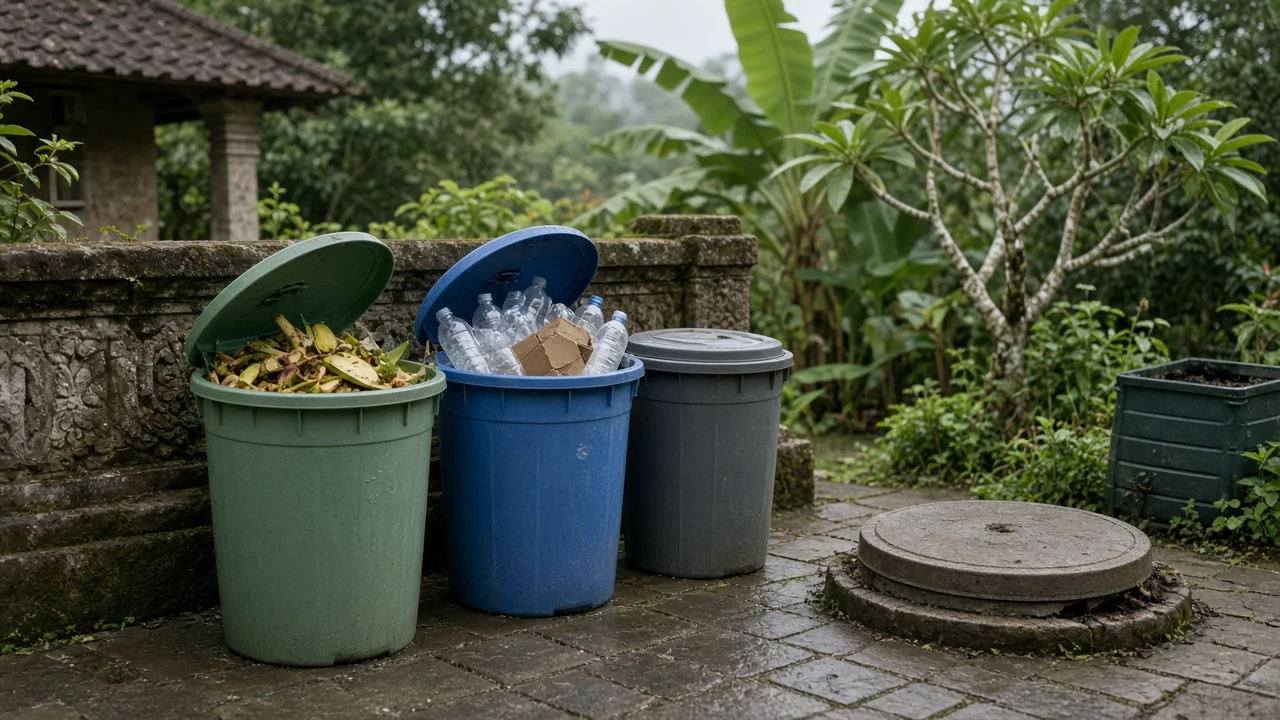
For years, rubbish in much of south Bali was something you could leave at the gate and forget. One bag, everything mixed, gone by morning. In Denpasar and Badung that habit has quietly stopped working. Collectors in some neighbourhoods now leave unsorted bags where they are, village notices ask households to separate food scraps from plastic, and new arrivals are often surprised to find that the person collecting their rubbish expects them to have done some of the work first.
The reason is the Suwung landfill, the regional site that serves Denpasar and Badung. Its use has been restricted during 2026, from April it was meant to receive only waste that cannot be composted, and national officials said in October that it was close to full. This guide explains what changed, how household sorting works in practice, what to do with food and garden waste, and what renters, villa owners and longer stay visitors can usefully check.
Quick answer
In Denpasar and Badung, household rubbish now needs to be sorted at home. The basic split used by Denpasar's city government is three ways: organic waste (food scraps, leaves, vegetables), inorganic waste that can be sold or recycled (plastic, paper, metal) and residue that cannot be processed further (such as nappies, sanitary pads and cigarette butts). Bali's provincial rules go further and ask households to keep hazardous items such as batteries and old electronics separate as well. According to Denpasar's city government, only inorganic waste and residue have been taken to the Suwung landfill since 1 April 2026, so organic waste is expected to be composted at home or handled by a local village waste facility. If you rent, the most useful step is to ask your landlord or villa manager which collection service covers the property, on which days, and how they want rubbish sorted.
Key takeaways
- Suwung has not closed, but it no longer accepts organic waste. The Ministry of Environment said in June 2026 that landfills would stay open for residue while open dumping ends.
- In October 2026 the Deputy Minister of Environment warned that Suwung could reach capacity within two to three months.
- Many collectors will not take unsorted bags. In some villages organic waste is not collected at all and must be dealt with at home.
- Composting is the main answer for food and garden waste: a compost bin, a compost bag or a teba modern, a covered pit about two metres deep.
- Recyclables go to a bank sampah (waste bank) or village recycling facility; residue goes in the bin for collection.
What changed at Suwung
The story of Suwung's "closure" has shifted several times this year, which explains some of the confusion among residents.
In January 2026, Bali Post reported that the planned closure had been pushed back to November 2026, while Badung's environment and sanitation agency (DLHK Badung) worked to reduce waste at source by making sure every village had a waste processing facility. At a coordination meeting in March, the Regent of Badung said Suwung would accept only residual waste from 1 April 2026 and would close in August, and the Governor of Bali asked villages and customary villages (desa adat) to make sorting at source happen in every household.
Then, in June, the Minister of Environment visited Suwung and said plainly that landfills in Indonesia, including in Bali, would not be closed. What has to stop, he said, is open dumping: piling up rubbish without proper management. Landfills may keep receiving residue, but not organic waste. The ministry also said that around 71 percent of people in Bali were already sorting their waste at source.
The pressure has not gone away. During an inspection on 22 October 2026, Deputy Minister of Environment Diaz Hendropriyono said that within two to three months Suwung would be over capacity and unable to accept more waste, and urged people to deal with waste at home rather than send it to the landfill. MetroBali, reporting on a provincial coordination meeting on 18 November, noted that Bali's provincial environment head had put Suwung's intake at around 1,100 tonnes a day on 12 November.
For households, the practical result is the same whichever headline you read: organic waste is no longer meant to leave your home mixed with everything else.
The categories, in plain terms
Denpasar's official FAQ on source based waste management uses three main categories. Bali's Governor Regulation No. 47 of 2019 on source based waste management asks households to sort into at least five, adding reusable items and hazardous waste. In everyday terms, it looks like this:
- Organic. Examples: food scraps, fruit and vegetable peel, fresh and dry leaves, garden clippings. Where it usually goes: compost at home, or a village waste facility (TPS3R) if your area offers that service.
- Inorganic, recyclable or reusable. Examples: clean plastic, paper and cardboard, metal cans, glass. Where it usually goes: a waste bank (bank sampah), a village recycling facility, or sorted collection.
- Hazardous household waste. Examples: used batteries, fluorescent tubes, car batteries, printer cartridges, expired medicines, electronics. Where it usually goes: kept separate and handed to a TPS3R, which passes it on to a licensed facility.
- Residue. Examples: used nappies, sanitary pads, used tissues, cigarette butts. Where it usually goes: the bin for collection; this is what the landfill is now meant for.
A TPS3R is a small local facility, usually run at village or customary village level, where waste is collected, sorted, reused and recycled. The "3R" stands for reduce, reuse and recycle. Coverage is uneven: in January 2026, DLHK Badung said 46 of Badung's 64 villages and urban wards had one, with 41 operating, and that North Kuta district had none yet. That may have changed since, so it is worth asking locally.
Dealing with organic waste at home
Organic waste is the heavy, wet part of most household rubbish, and it is the part the new system is designed to keep out of the landfill. Denpasar's FAQ lists three home methods.
Compost bin
A closed compost bin (tong komposter) suits most houses and villas with a little outdoor space. According to the city's FAQ, compost is ready in roughly 30 to 40 days if the process is followed properly. An activator such as EM4 is optional; it can speed things up but is not required.
Compost bag
The city also lists compost bags (bag komposter) as an option, alongside bins and pits.
Teba modern
A teba modern is a covered pit about two metres deep, usually lined with concrete, into which sorted organic waste is placed to break down naturally. detikBali describes it as an adaptation of traditional Balinese ways of managing waste, and reported in 2025 that one costs roughly Rp1 million to Rp1.5 million to build and fits in a house yard, temple, office or school. The founder of the community group that helped Denpasar introduce the pits has said one does not fill up within eight to nine months because the contents keep decomposing. A vertical version (teba vertikal) works in the same way in a smaller footprint.
What can and cannot go in
The city's guidance is simple:
- Yes: fresh leaves, fruit and vegetable scraps and herbivore manure ("green" material), plus dry leaves, sawdust and paper ("brown" material).
- No: meat, fish and bones; oil, fat and coconut milk; dairy products; and the droppings of carnivorous animals, which includes most pets.
The FAQ suggests a ratio of about two parts brown to one part green. If the compost becomes too wet, add more dry leaves or sawdust; if it is too dry, spray it with water or rice water. In Denpasar, households can ask their lurah or perbekel (head of the urban ward or village) about the city's free composter distribution programme.
Recyclables, hazardous items and residue
Recyclables. Denpasar's FAQ directs inorganic waste to the nearest waste bank in your village or ward. Provincial rules describe waste banks as places that sort and collect recyclable or reusable waste that has economic value. Rinsing containers and keeping paper dry makes them more useful to whoever handles them next.
Hazardous items. Under the 2019 provincial regulation, household batteries, fluorescent tubes, car batteries, cartridges, expired medicines, contaminated packaging and electronics should be kept separate and collected at a TPS3R, then taken to a dedicated hazardous waste store at regency or city level. In practice, a separate box or bag in a cupboard is enough until you know where your local facility accepts them.
Residue. This is what remains once organic, recyclable and hazardous waste are taken out. It is the only household category now intended for Suwung, which is one reason officials are keen for it to be as small as possible.
How collection works in practice
There is no single island wide system. Collection in Denpasar and Badung may be arranged through the customary village, a village waste facility, a village owned enterprise or an independent collector, and rules can differ from street to street. Two examples from local reporting show the range.
In Desa Adat Yangbatu in east Denpasar, detikBali reported in January 2026 that the customary village's waste service had stopped collecting organic waste and coconut shells because it had no facility to process them. It collects inorganic waste two to three times a week, but only if it has been sorted. The village head said residents who did not sort received warnings and could have their rubbish left behind.
In Sanur Kaja, the coordinator of the local TPS3R told detikBali in April 2026 that collectors had moved to picking up sorted rubbish from inside home compounds, because bags left on the street attracted rubbish dumped by passers by. Subscribers were asked to leave their gates unlocked during collection hours. He also noted that some residents labelled bags containing broken glass as a warning to collectors, a small courtesy that makes a real difference to the people doing the job, and said owners of rented rooms (kos) should take responsibility for briefing their tenants.
Denpasar's FAQ is clear that sorting is expected of everyone: households, residential and commercial estates, hotels, restaurants and cafés, schools, offices and businesses. Apartments are expected to provide organic waste facilities for residents. The city lists sanctions for not sorting, starting with verbal or written warnings and a delay in collection, and names the city environment agency, the lurah or perbekel, and the city call centre as places to raise problems.
If you rent, own a villa or are staying a while
Waste is rarely mentioned when people view a house in Bali, yet it is now one of the first practical questions worth asking. A few points cover most situations:
- Ask who collects, and when. Find out whether the property uses the banjar service, a village enterprise or a private collector, which days they come, and whether a monthly fee is included in your rent.
- Ask how they want it sorted. Some services want two streams, others three or more. Some take organic waste and some do not.
- Check for composting space. If organic waste is not collected, a compost bin or an existing teba on the property becomes important, especially for families who cook at home.
- Brief everyone in the house. Household staff, guests and short term tenants may follow different habits. A simple note by the kitchen bins helps.
- For absentee owners. Ask your villa manager how waste is handled when the property is let, particularly at busy times such as the Christmas and New Year holidays, when guest numbers rise.
Keeping waste out of roadside drains matters too. Rubbish left in a drain can block it during heavy rain or end up in a river and, eventually, on a beach. Our rainy season guide covers drains and flooding, and our guide to Bali's beach rubbish season explains where river waste goes once it reaches the sea.
Frequently asked questions
Has the Suwung landfill closed?
No. The Ministry of Environment said in June 2026 that it would not be closed, but it now accepts only residual waste rather than everything. In October 2026 the Deputy Minister warned that it could be over capacity within two to three months, which is why officials are pressing households to sort and compost.
Do these rules apply outside Denpasar and Badung?
Bali's provincial regulation on source based waste management applies across the province, but the details of collection are set locally. Denpasar and Badung are where the change has been felt most because Suwung serves them. Elsewhere, ask your banjar or village office how collection works.
I am only in Bali for a few weeks. Do I need to sort?
Yes, in practice. Follow whatever system your accommodation uses. Keeping food scraps separate from plastic and paper is usually the most important step.
Where does sorted waste go?
Recyclables go to waste banks and village recycling facilities. In January 2026, DLHK Badung said that as more residents sort their rubbish, some waste is now handled at village facilities and some is sent to the Mengwitani waste processing site.
Who do I contact if collection stops?
Start with whoever provides the service, usually your banjar, village or collector. In Denpasar, the city FAQ lists the city environment agency, the lurah or perbekel, and the city call centre.
Continue exploring
- Bali's beach rubbish season: why it happens, which beaches are affected and how to help
- Bali's 2026/27 rainy season: a practical guide for residents, renters and villa owners
- Five things to understand before you call Bali home
- Beyond the Bali Facebook Group: finding advice you can trust
Settling in, one routine at a time
Rubbish is not the most glamorous part of moving to Bali, but it is one of the everyday systems that shows how life on the island really works: local, community based and changing quickly. If you are setting up a home here and would like help understanding how things work in your area, you are welcome to start a conversation with Touchstone about your circumstances.
By Touchstone Bali. Published 22 November 2026. Collection arrangements differ between villages and change often; check with your banjar, village office or collector for current local practice.
References
- FAQ Pengelolaan Sampah Berbasis Sumber di Kota Denpasar, Pemerintah Kota Denpasar, 2026.
- Peraturan Gubernur Bali Nomor 47 Tahun 2019 tentang Pengelolaan Sampah Berbasis Sumber, JDIH Provinsi Bali.
- Bukan Tutup TPA, Menteri LH Tegaskan Stop Open Dumping dan Dorong Ekosistem Green Jobs di Bali, Kementerian Lingkungan Hidup, 9 June 2026.
- Menteri LH Pastikan Tak Ada Penutupan TPA di Seluruh Indonesia, detikBali, 9 June 2026.
- Wamen LH Desak Penyelesaian Pengolah Limbah Air Lindi TPA Suwung untuk Selamatkan Ekosistem Mangrove Bali, Kementerian Lingkungan Hidup, 24 October 2026.
- Dy minister urges completion of Suwung waste treatment facility, ANTARA, 25 October 2026.
- Data Sampah Denpasar dan Badung Dipertanyakan, Tonase ke TPA Suwung Belum Terverifikasi, MetroBali, 18 November 2026.
- Rakor Percepatan Penanganan Persampahan di Kabupaten Badung, Bupati Tekankan Pemilahan Sampah Mulai dari Rumah Tangga, Pemerintah Kabupaten Badung, 9 March 2026.
- Penutupan TPA Suwung Diundur, Badung Tetap Genjot Pengelolaan Sampah dari Hulu, Bali Post, 20 January 2026.
- TPA Suwung Dibuka Terbatas, Desa Adat Yangbatu Tak Lagi Angkut Sampah Organik, detikBali, 20 January 2026.
- Marak Titip Sampah, Sanur Kaja Terapkan Sistem Ambil dari Dalam Rumah, detikBali, 15 April 2026.
- Teba Modern, Lubang Ajaib Pengurai Sampah di Bali, detikBali, 13 August 2025.
- Walikota Jaya Negara Resmi Luncurkan Teba Modern di Kota Denpasar, Pemerintah Kota Denpasar, August 2024.