
Relocation & Lifestyle · 23 November 2026
Food Prices in Bali Are Rising: A Practical Guide to Market Prices, Inflation and Your Household Budget
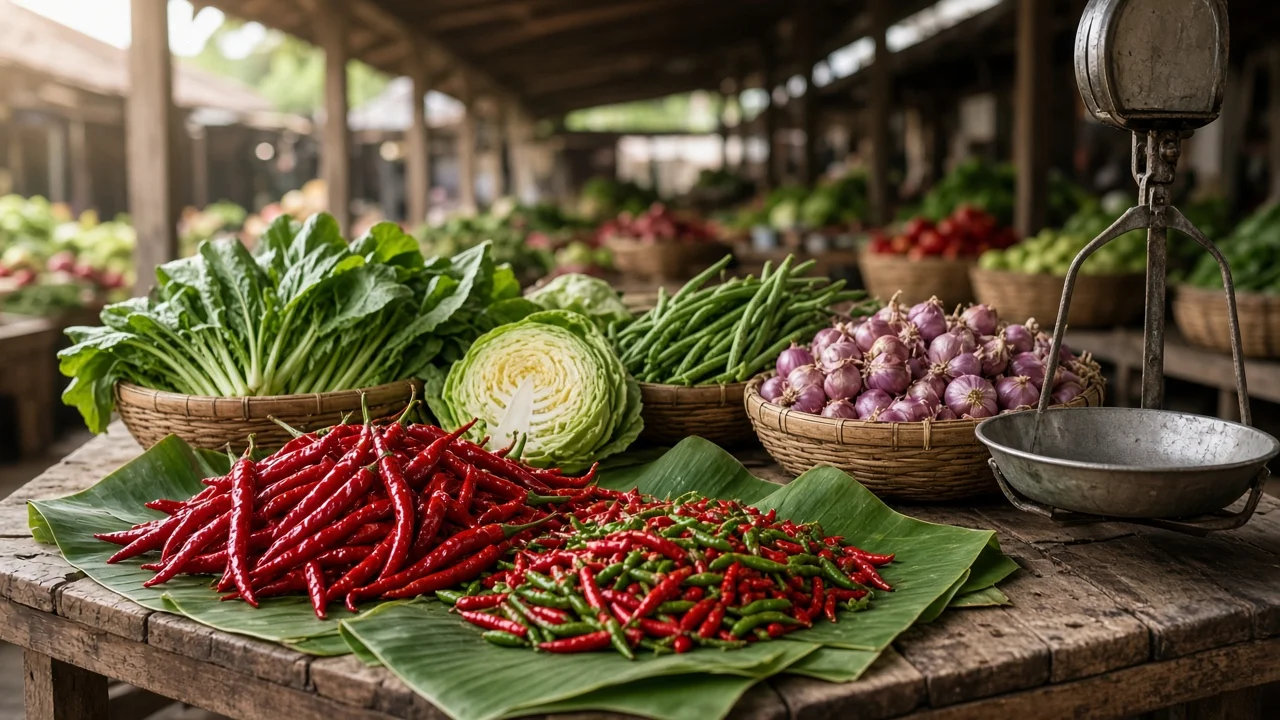
If your weekly shop in Bali has felt more expensive lately, the official numbers agree with you. A bag of chillies, a bunch of greens and a cabbage all cost noticeably more in October than they did in September, and petrol, cooking oil and eating out have crept up over the past year. For anyone running a household here, whether you cook for yourself, rely on a cook or housekeeper, or manage a villa that stocks a kitchen for guests, those small rises add up.
This guide explains what Bali's latest inflation figures actually show, which everyday items have risen and why, what local officials expect next, and how to check market prices yourself before you shop. It is a practical household guide, not financial advice.
Quick answer
According to Statistics Indonesia's Bali office (BPS Bali), prices across the province were 3.87 percent higher in October 2026 than a year earlier, and 0.25 percent higher than in September. The biggest monthly rises were in fresh produce: red chillies, bird's eye chillies, mustard greens, cabbage and green beans, which BPS linked to a long dry season that cut harvests while demand stayed the same. Pork also rose, which BPS attributed to more expensive animal feed. Over the year, petrol, cooking oil, rice and vehicle servicing contributed most. You can check average market prices for staples across Bali, by regency and by date, on the provincial government's free Sigapura price website, and Denpasar shows daily average prices on a public screen outside the mayor's office.
Key takeaways
Bali's annual inflation reached 3.87 percent in October 2026, above the upper end of the national target range of 1.5 to 3.5 percent, and higher than the 3.23 percent recorded nationally.
Food, drink and tobacco rose 5.16 percent over the year, the largest contribution to inflation. Transport rose 6.90 percent and restaurant meals 4.11 percent.
Among the four areas BPS measures, Tabanan had the highest annual inflation (4.35 percent) and Denpasar the lowest (3.63 percent). Badung had the sharpest monthly rise in October (0.52 percent).
Bank Indonesia's Bali office expects prices of some foods to normalise and vegetable supplies to recover gradually, but warned that a late rainy season and El Niño could keep pressure on food supplies into early 2027.
Government cheap food sales and market operations have been running in Denpasar and Buleleng ahead of the year end holidays.
What the October 2026 figures show
BPS Bali publishes a consumer price index each month, based on prices collected in four areas: Denpasar, Badung, Tabanan and Singaraja. Its October 2026 release, published on 2 November, put annual inflation at 3.87 percent, up from 2.51 percent in October 2024 and 2.61 percent in October 2025. Bali Post reported the head of BPS Bali saying that this was the highest October figure compared with previous years, and fairly high even by the standards of 2026. Bank Indonesia's Bali office noted that the figure had risen from 3.79 percent in September.
Prices for the first ten months of the year were 2.74 percent higher than in December 2025. By area, annual inflation was 4.35 percent in Tabanan, 4.16 percent in Badung, 3.67 percent in Singaraja and 3.63 percent in Denpasar.
It helps to remember what these numbers mean. Inflation of 3.87 percent is an average across a wide basket of goods and services, weighted by what typical households buy. Your own costs may have risen faster or slower, depending on how much of your budget goes on fresh food, fuel, eating out or imported goods.
Which everyday items rose, and why
Chillies and vegetables
Fresh produce drove most of October's monthly increase. According to BPS, red chillies rose 51.43 percent in a single month and bird's eye chillies (cabai rawit) 12.23 percent; together they accounted for about 60 percent of October's monthly inflation. Mustard greens (sawi hijau) rose 55.58 percent, white cabbage 51.81 percent and green beans 30.26 percent.
The head of BPS Bali explained that a long dry season had sharply reduced horticultural production while demand stayed steady. Over a full year, bird's eye chillies were 99.26 percent more expensive than in October 2025, roughly double.
Pork
Pork, a staple of Balinese cooking and ceremonies, rose 2.56 percent in October. The head of BPS Bali said feed prices had climbed sharply over recent months, and suggested that feed ingredients such as corn and rice bran had probably been affected by the dry weather too. Bank Indonesia's Bali office added that pork supplies were limited at a time of high demand.
Petrol, cooking oil and rice
Over the year, petrol was the single largest contributor to inflation, up 8 percent on October 2025. Bali Post reported that BPS linked this to fuel price adjustments in May and June 2026. Cooking oil was up 10.23 percent, rice 2.40 percent and vehicle maintenance and servicing 7.37 percent. BPS also noted the fuel supply disruption of 11 to 15 October 2026, which caused long queues at petrol stations and delayed some deliveries.
Some prices fell
Not everything went up. In a written statement, Bank Indonesia's Bali office said that lower prices for chicken, shallots, garlic and tuna helped hold October's increase down.
What prices look like now
Since the October figures, the picture has been mixed. On 9 November, the Tabanan trade office told Bali Post that more chillies arriving from Java had brought large red chillies down from Rp50,000 to Rp40,000 a kilo in the regency's markets, while some vegetables stayed expensive because local harvests had not yet picked up.
For a snapshot across the island, IDN Times reported the following Sigapura averages for 21 November 2026, per kilo unless stated:
Rice: premium Rp16,100; medium Rp15,123; government SPHP rice Rp11,807.
Chillies: bird's eye chillies Rp60,464; large red chillies Rp39,036.
Shallots and garlic: shallots Rp28,452; garlic Rp30,607.
Cooking basics: sugar Rp18,925; cooking oil Rp21,652 a litre.
Meat, eggs and fish: pork Rp87,741; beef (outer loin) Rp119,750; chicken Rp40,696; eggs Rp27,585; tuna (tongkol) Rp34,925.
Vegetables: water spinach (kangkung) Rp7,321; long beans Rp12,887.
In the same IDN Times series, the average for bird's eye chillies was Rp52,125 on 4 November, and pork was Rp76,125, so both had risen again during November. These are averages across monitored markets; what you pay on a given day will vary by market, stall, quality and quantity.
Prices also differ by area. In the provincial government's report for 7 November, based on 60 markets across Bali, beef averaged Rp157,462 a kilo in Denpasar and Rp147,000 in Badung, compared with Rp125,000 in Gianyar. Bird's eye chillies averaged Rp62,744 in Denpasar and Rp61,500 in Badung, against a provincial average of Rp56,629.
What officials expect next
Bank Indonesia's Bali office said on 3 November that it expected prices of some foods to normalise after October's rises, and horticultural supply to recover gradually, which could hold down inflation in November. It also flagged risks. A strong El Niño was forecast to continue into early 2027, most of Bali was not expected to enter the rainy season until December 2026, and high global energy prices could raise distribution costs. It said inflation control needed strengthening over the last two months of the year so that Bali ends 2026 within the target range of 2.5 percent plus or minus 1 percent.
The rainy season matters here because it affects harvests. Our guide to Bali's 2026/27 rainy season explains the official forecasts for when the rains arrive in different parts of the island. Holiday demand also plays a part, and our Christmas and New Year planning guide covers the busiest travel days.
How to check prices before you shop
Sigapura, the provincial price website
Sigapura is the Bali provincial government's information system for staple food and strategic commodity prices. On its price page you can choose a market type, a commodity and a regency, set a date range, and view the results as a table or a chart. It is in Indonesian, but the commodity names are easy to learn: beras (rice), cabai (chilli), bawang merah (shallots), bawang putih (garlic), telur (eggs), daging ayam (chicken) and daging babi (pork).
Checking the average before a big market trip gives you a reference point. If a price is far above the regency average, it may be worth comparing another stall.
Denpasar's public price screen
In November, the Denpasar city government has shown daily average prices for staple goods on the videotron screen outside the mayor's office on Jalan Udayana. City officials told Bali Post the figures combine the trade office's monitoring of sample markets with provincial data, and that they are average prices rather than exact ones. The aim, they said, is to give residents accurate information and avoid panic buying of the kind seen during the October fuel queues.
Local news price round ups
Several Bali news outlets publish regular price round ups based on Sigapura data. They are a quick way to follow the trend, but the official site lets you filter by your own regency.
Cheap food markets and market operations
Government agencies run discounted food sales and market interventions to steady prices, especially before holidays. Recent examples include:
Market operations in Denpasar's two biggest markets. Perumda Pasar Sewakadarma, Denpasar's municipal market company, told Bali Post on 6 November that it was monitoring prices daily with sample traders at Pasar Badung and Pasar Kreneng and subsidising some products, covering items from shallots, chillies, eggs, rice and instant noodles to sugar, flour, fish and canang sari. It said its schedule of operations was full until the end of the year.
A cheap food drive by BULOG. The state food logistics agency held a Gerakan Pangan Murah (cheap food movement) in Denpasar and at the Buleleng car free day on 15 November, selling SPHP rice, premium rice, cooking oil and sugar below market prices ahead of Christmas and New Year.
Subsidised offerings at a community market. At a pasar rakyat (people's market) in Lapangan Puputan Badung, Denpasar, on 13 November, about 500 subsidised Tumpek Landep offering packages sold for Rp15,000 instead of the usual Rp41,000, and sold out that morning, limited to one per person.
Dates and locations are announced through local government and news channels, and quantities can be limited, as the one package per person rule at the people's market showed. These sales are aimed at the wider community, so it is worth being considerate about buying in bulk.
Practical ways to manage a household food budget
None of this calls for dramatic changes, but a few habits can make rising prices easier to absorb.
Know your reference prices. Note what you normally pay for your regular basket, and compare it with the Sigapura average for your regency every few weeks. It makes sudden jumps easier to spot.
Shop the season, not the recipe. When a vegetable spikes because of a poor harvest, another is often still cheap. In the 21 November averages, water spinach cost a fraction of chillies or garlic per kilo.
Buy volatile items in smaller amounts. Chillies and leafy greens have been the most volatile items this year and spoil quickly. Buying what you need for a few days avoids paying peak prices for food you throw away.
Compare traditional markets and supermarkets. Prices vary between outlets and areas, as the gap between Denpasar, Badung and Gianyar averages shows. Many residents mix both.
If someone shops for your household, agree a budget together. A cook, housekeeper or villa manager may already be absorbing higher market prices. Reviewing the shopping allowance against current averages is fairer than assuming last year's figure still works.
Budget for fuel and eating out separately. Transport costs rose 6.90 percent over the year and restaurant meals 4.11 percent, so these lines may need adjusting even if your grocery bill feels stable.
Keep food scraps out of the bin. Peelings and trimmings from fresh produce can be composted. Our guide to sorting household rubbish in Denpasar and Badung explains how.
If you are planning a move or a longer stay
One common mistake is to estimate living costs from a holiday budget. A realistic plan separates the costs that move with the market, such as fresh food, fuel and imported goods, from the ones that are fixed for a period, such as rent agreed in advance. Our article on five things to understand before you call Bali home looks at budgeting and other practical questions in more detail.
Frequently asked questions
Is Bali more expensive than the rest of Indonesia right now?
In terms of the rate of price increases, yes. Bali's annual inflation of 3.87 percent in October 2026 was higher than the national figure of 3.23 percent, according to Bank Indonesia's Bali office. That measures how fast prices are rising, not the absolute cost of living.
Why are chillies so expensive in Bali?
BPS Bali attributed the October rise to a long dry season that reduced harvests while demand stayed steady. Bird's eye chillies were roughly double their price of a year earlier. In Tabanan, extra supply from Java brought some chilli prices down in early November, but the Bali wide average for bird's eye chillies rose again later in the month.
Will prices come down when the rainy season starts?
Bank Indonesia's Bali office expects vegetable supplies to recover gradually, but it also warned that a late rainy season and El Niño could keep pressure on food supplies into early 2027. It is sensible to treat current prices as a guide rather than a forecast.
Where can I find official price data?
BPS Bali publishes monthly consumer price index releases on its website, and the provincial government's Sigapura site shows average market prices for staple foods by regency and date.
Are imported groceries affected too?
The official figures discussed here focus on the items that drive Bali's price index, most of them local staples. BPS did note a 9.17 percent monthly rise in laptop and notebook prices in October, which it linked to a stronger US dollar, so imported goods can move with the exchange rate. Check prices at your usual shops.
Continue exploring
Bali's 2026/27 rainy season: a practical guide for residents, renters and villa owners
Christmas and New Year in Bali 2026/27: a practical guide to dates, crowds and travel
Sorting household rubbish in Denpasar and Badung: a practical guide
Planning everyday life in Bali
Rising market prices are one of the quieter realities of living in Bali, and they are easier to manage when you know where to look. If you are settling in, planning a longer stay or setting up a household and would like to talk through how daily life works here, you are welcome to start a conversation with Touchstone about your circumstances.
By Touchstone Bali. Published 23 November 2026. Prices quoted are official or reported averages on the dates stated and change frequently; check current figures before relying on them.
References
BPS Provinsi Bali, Perkembangan Indeks Harga Konsumen Oktober 2026 Provinsi Bali (official statistics release, 2 November 2026)
Bali Post, Inflasi Bali Lampaui Batas Atas Sasaran Nasional (2 November 2026)
Kompas, Kemarau Panjang Picu Harga Sayur dan Daging Babi di Bali Melonjak (3 November 2026)
Berita Bali Online, Oktober 2026, Inflasi di Bali Alami Penurunan, Sinergi Pengendalian Inflasi Terus Diperkuat (Bank Indonesia Bali written statement, 3 November 2026)
Bali Post, El Nino Ancam Pasokan Pangan Bali, Inflasi Berisiko Berlanjut hingga Awal 2027 (4 November 2026)
Bali Post, Pasokan dari Jawa Bertambah, Harga Cabai di Tabanan Mulai Turun (10 November 2026)
Pemerintah Provinsi Bali, Sigapura: Harga Pangan (official price information system)
Bali Media Center, Pemerintah Provinsi Bali, Pantauan Harga untuk 7 Komoditas Prioritas di Provinsi Bali Tanggal 07 November 2026 (8 November 2026)
IDN Times Bali, Harga Beras dan Pangan di Bali 21 November 2026 Berdasarkan Sigapura (21 November 2026)
IDN Times Bali, Harga Cabai dan Pangan Lainnya di Bali 4 November 2026 (4 November 2026)
Bali Post, Harga Kebutuhan Pokok Dipajang pada Videotron di Denpasar, Ini Alasannya (6 November 2026)
Bali Post, Tekan Inflasi, Operasi Pasar Sasar Dua Lokasi di Denpasar (6 November 2026)
Radar Bali, Jelang Nataru 2026/2027, BULOG Bali Gelar Gerakan Pangan Murah Serentak di Denpasar dan Buleleng (16 November 2026)
Bali Post, Pasar Rakyat di Lapangan Puputan, Paket Banten Tumpek Landep Habis dalam Sekejap (13 November 2026)